Richmond Lab Hatching and Electrocution
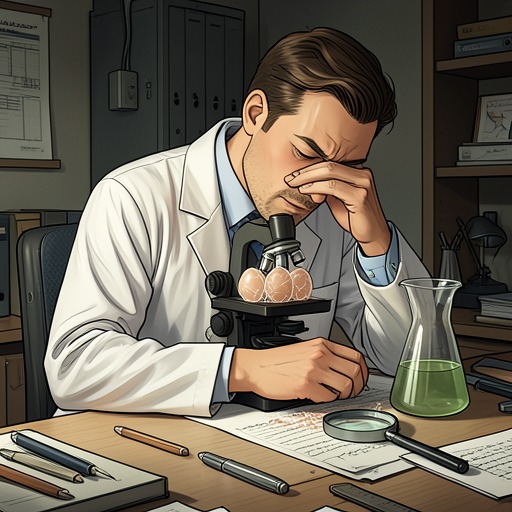
Secret InvasionThe Richmond Lab Hatching and Electrocution begins as an attempt to study an unidentified egg and becomes the first direct laboratory encounter with young Sliggers. Leslie Bickers cannot identify the animal developing inside, even under 400X magnification. When the egg begins to move, she returns it to the tank beside two others; almost immediately, its shell ruptures and the creature inside forces its way out. The hatching reveals both the animals’ startling anatomy and the threat they pose when confined only by laboratory equipment.
Hatching and Containment
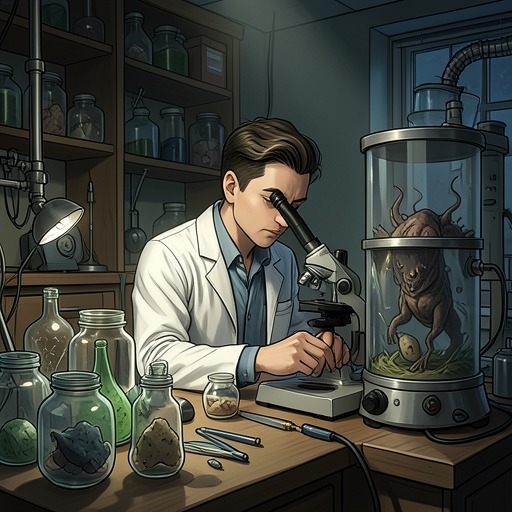
The first hatchling emerges in stages: a dark-green head slick with amniotic fluid, jet-black eyes, a long-toothed jaw, three pairs of tentacle-like appendages, amphibious legs, and a reptilian tail. Its mixture of features appears to span at least four animal classes, defying Leslie’s biological expectations. As the creature pulls itself from the egg, the other two begin to open as well. What might have been a close examination of one specimen is suddenly the emergence of three.
The first hatchling reacts aggressively to Leslie. It hisses, charges the Plexiglas, and tries to climb out through the open top. She quickly secures the steel mesh cover over the tank. The animal continues searching for a way out, and its newly alert siblings join the effort, striking the cover with enough force to make Leslie reinforce it with thick textbooks. The improvised weight holds the lid down for the moment, but their vigorous attacks make plain how precarious the enclosure is.
As Leslie watches the creatures, fascination gives way to recognition. Their appearance matches accounts of sea monsters reported in South Carolina the previous year and again in recent news: recovered body parts and witness descriptions now have a living counterpart in the tank. The laboratory scene therefore connects the anomalous eggs to an already unfolding coastal threat. Its immediate danger is contained, but the resemblance identifies the hatchlings as part of a wider crisis rather than an isolated scientific puzzle.
Escalation and Destruction
The hatchlings’ danger becomes undeniable when two turn on the third. They tear into it from opposite sides; within a minute, the victim lies lifeless, shredded, and open, while the surviving pair begin to feed. The laboratory’s specimens are not merely aggressive toward people: they are predators capable of killing and consuming one another. Earlier testing had made the danger measurable in another way. A mouse placed in the tank was stung by the creatures’ barbed tentacles and died in four minutes; almost all of it was eaten, with the remains left underwater.
Once the surviving hatchlings have fed, they turn their attention back to the people watching them. They strike the Plexiglas with their appendages and ram the tank hard enough to shake it. The group steps back as another lunge shoves the entire tank an inch closer to the counter’s edge. Above it, the steel mesh rattles despite the heavy textbooks still holding it down. The makeshift enclosure that had kept the newly hatched animals inside now appears close to failing under their repeated assaults.
Ron Tully concludes that keeping the hatchlings alive is no longer safe: they must be destroyed before they escape and attack. A scalpel would require someone to reach close enough to be stung, while fire would be ineffective in a water-filled tank. He instead takes a desk lamp, pulls its cord away from the base, checks that the wires are exposed, and feeds them through an opening in the mesh. Electricity from the outlet spreads through the tank water. The hatchlings convulse as the current seizes their muscles, then fall limp when their hearts stop. Their destruction ends the immediate laboratory threat, but the encounter has also shown how quickly a contained specimen can turn into an emergency.
Scientific Meaning and Ecological Stakes
The laboratory could display what the hatchlings were, but not explain how they had come to be. Their combination of traits from several animal classes suggested profound biological disruption; later tissue analysis by Denise Baddington still yielded no conclusive identification. Samples of residue recovered from the old Nazi U-boat beneath Wrecker Island had not yet produced test results, so the proposed cause remained a hypothesis rather than a confirmed finding.
Denise suspected that the substance developed by German and Japanese scientists had been intended to induce genetic mutation when introduced into an organism’s DNA. In her account, generations of creatures feeding on other species could acquire and mutate with the DNA of their prey, helping explain their mixed characteristics. The hatchlings’ bodies thus became an ominous piece of evidence in a larger investigation: a visible biological anomaly whose origin was thought to lie in a long-ago leak into the ocean.
The danger extended beyond any creature escaping the tank. Later guidance stressed that killing Sliggers carelessly could spread their mutated tissue through the water, where other animals might eat it and continue the contamination through the food chain. Denise therefore urged responders to recover all tissue and burn the carcasses cleanly. In retrospect, the hatchlings’ destruction addressed the immediate threat to the laboratory staff, while the conditions that produced the animals demanded a wider form of containment—one concerned not only with living predators, but also with what their remains might pass on.
From Laboratory Specimens to a Regional Emergency
The Richmond hatchlings’ behavior was an early warning of the larger problem, not an isolated laboratory danger. As reports accumulated from a Georgia campground and a Florida beach near St. Augustine, Denise Baddington concluded that the widely separated incidents pointed to multiple nests, eggs, and creatures along the coast. Later assessments traced another route of spread to coastal currents in the Gulf of Mexico, carrying Sliggers eastward from the Texas-Louisiana border. The crisis was therefore not simply a matter of one enclosure failing: nests and waterways connected local encounters into a broad, moving infestation.
The response eventually depended on finding nests and eliminating them before the creatures could spread farther. Four days after the hotel attack in Baton Rouge, Army Reserve troops located and destroyed a nest near the Mississippi River. Ron Tully’s team continued north with the searchers as far as St. Francisville; after they covered another forty miles of waterways without finding a monster, officials judged that the spread up the river had been stopped. Ron’s report also noted two traits with consequences beyond the Richmond incident: the animals could reproduce asexually and evolve rapidly in response to different environments. The laboratory episode had shown the immediate danger of hatching and containment; the later campaign revealed the scale of the work required to prevent that danger from becoming an ecological invasion.